The ACEI continued to push the political system in June to improve the environment for consulting engineers.
Overview:
Accelerating Infrastructure
- The Secretariat submitted a report on delays and issues on the ground to Sean O’Driscoll and Imelda Mannion of the Accelerating Infrastructure Taskforce including key topics of concern around NCCs and median-priced tendering.
- The ACEI, through the CIC, submitted information relating to delays on the ground when dealing with contracting authorities to the Dept of Public Expenditure.
- DG, Shane Dempsey met with Assistant Secretary, Jasmina Behan to outline delays and challenges around contractual and procurement practices (listed above).
- The ACEI attended the Construction Sector Group (led by the Department of Public Expenditure and involving all Government Departments engaged in capital investment. When there, the ACEI made the case for proportionate liability and the need for better contractual conditions for those engaged in HFA projects.
- DG Shane Dempsey will participate in the Department’s ‘Accelerating Infrastructure Productivity’ working group (7th July).
- ACEI Secretariat attended the DPER Infrastructure Conference on 8th July to hear from Minister Chambers on the work being done at department level to allocate risk more fairly and increase the risk appetite for project delivery.
DOEY Clearing House
- Following feedback from members, ongoing negotiations with the DoEY relating to late payments and legacy projects remain productive with weekly meetings now occurring between the Department and the ACEI.
- This has been a particularly important issue for many of our SME firms where the payment structure of DoEY has a more significant impact.
- In this light, there was a webinar on 30th June with DoEY on its plans for changes to ways of working and we’ll be sending round key highlights to member firms in the coming weeks.
- The ACEI is seeking to establish similar clearing houses with the OPW
Contractual issues – NCCs / HFA collateral warranties
- The ACEI has written to the Law Society to address issues where legal firms are advising their clients to disregard ACEI’s Conditions of Engagement documents.
- The ACEI has also submitted a query to the Construction Sector Capacity and Procurement Unit in relation to the use of unfair contractual terms by the HFA.
- The ACEI has also requested a follow up meeting with the Department of Housing and Minister for Housing on the HFA’s unfair contractual terms. This follows a meeting in Leinster House in January this year.
- The ACEI and other professional bodies will soon be launching a joint communique on the need for NCCs in public sector contracts.
Queries
- The ACEI addressed procurement issues on behalf of members with the National Transport Authority, TII, HFA and LDA in the past month.
Upcoming meetings:
- The ACEI will meet with the Department of Transport on July 16th following a request by Minister Darragh O’ Brien.
- DG Shane Dempsey will attend a forum in the Department of An Taoiseach’s ‘Industry Capability Working Group’.
If you need support or guidance on any issue affecting your firm, please contact DG, Shane Dempsey or Senior Policy Advisor, Dónal O’Neill. We’re here to help.
Welcome to the latest public affairs digest from the ACEI (covering April 2026).
The ACEI Secretariat was again busy this month on the stakeholder engagement front meeting with;
- 2 Contracting Authorities
- 1 Departmental Meeting
- 1 TD
- 1 Meeting of CIC Group
Political Backdrop:
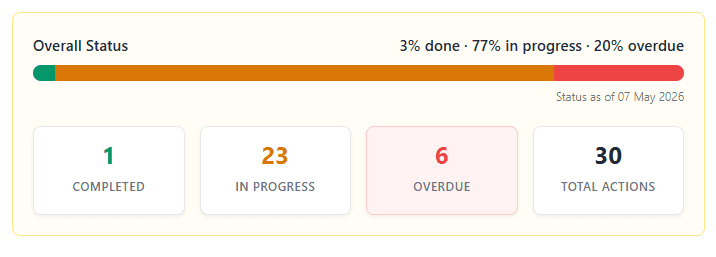
International events in Iran continue to hold centre stage as the Accelerating Infrastructure Bill progresses through the Oireachtas. It is worth noting that as we move towards May/June the indicator from ProgressIreland is that more of the Government’s actions are slipping into the ‘Overdue’ section of their tracker. Though still very early, this points to some initial friction between government ambition and implementation. The tracker can be viewed here https://infrastructuretaskforce.org/
Current Tracker Progress on Government Actions
As highlighted at our Member’s only webinar on May 5th, the government is resisting any introduction of NCCs at present and the HFA remains unwilling to adopt different contractual terms. What is working is you the member fighting for NCCs on contracts. This changes government perception on what is considered ‘standard’ industry practice and increases the likelihood of movement on public sector work. Keep working together and demand these contractual arrangements where possible. We are working with the RIAI and others to have their members demand NCCs as well. We are also working with TDs to form Parliamentary Questions which will ensure the Government lays out its position on the record.
Key priorities for the sector and ACEI remain:
- Issues around collateral warranty extension within contracts from state-funded bodies.
- Introduction of more flexible contract types (to include NCCs)
- Median pricing on government procurement
ACEI Political Engagement:
2 April: OPW Flood Relief Engagement
21 April: Meeting with Department of Public Expenditure and Reform.
22 April: Meeting with Joe Neville TD (Infrastructure Committee)
22 April: Meeting between ACEI, Dept. of Education and Youth and other design bodies; RIAI and SCSI.
27 April: Meeting with OPW.
28 April: Meeting of the Irish Inter Professional Association (IIPA).
29 April: Department of Education and Youth Information Session
Remember: the ACEI will represent you directly with clients if and when issues arise. Contact Shane or Dónal, we can help.
Welcome to the latest public affairs digest from the ACEI (covering March 2026).
We’ve been busy again with 6 political engagements including;
- 1 Minister
- 2 TDs
- 2 Special Advisors and
- 1 Contracting Authority
Political Backdrop:
International events in Iran look soon to impact the Irish energy market with guidance from Government expected to conserve energy in the coming period. This puts into sharp focus Ireland’s continuing need to upgrade renewable infrastructure in the years ahead to expand our capacity to meet national demand from native sources. At national level, items are beginning to move onto the books to progress actions from the Accelerating Infrastructure taskforce. Progress across each of its actions can be followed here https://infrastructuretaskforce.org/
Despite our importance to delivery the government is resisting any introduction of NCCs at present and the HFA remains intransigent in adopting fairer contractual terms. What is working is you the member fighting for NCCs on contracts. This changes government perception on what is considered ‘standard’ industry practice and increases the likelihood of movement on public sector work. Keep working together and demand these contractual arrangements where possible. We are working with the RIAI and others to have their members demand NCCs as well.
Key priorities for the sector and ACEI remain:
- Introduction of more flexible contract types (to include NCCs)
- Median pricing on government procurement
- Issues around collateral warranty extension within contracts from state-funded bodies.
ACEI Political Engagement:
3 March: Secretariat work with TDs to answer and give guidance on Parliamentary Questions submitted to the Department for Infrastructure
3 March: Meeting in Merrion Hotel with Darragh Gallagher, Special Advisor to Minister Dara Calleary (Fianna Fáil)
5 March: Meeting with Harry Fay, former assistant to Paula Butterly (Fine Gael).
12 March: ACEI leaders meet with former Minister for Foreign Affairs, Simon Coveney on government engagement policy
19 March: Meeting with Conor Sheehan TD (Labour) *Rescheduled
19 March: Meeting with OPW on Flood Relief
24 March: Meeting with the Department of Education
25 March: Meeting with Minister of State at the Department of the Taoiseach, Thomas Byrne (Fianna Fáil)
26 March: Meeting with Deputy John Clendennen (Fine Gael)
Remember: the ACEI will represent you directly with clients if and when issues arise. Contact us, we can help.

We are delighted to announce the shortlist of projects for the 2026 Engineering Excellence Awards. There was a record number of entries this year, thanks to all firms who entered.
Congratulations to all of the shortlisted firms and projects, which can be seen here.
The presentation of the awards takes place at the Gala Dinner on Friday 27th March in the Intercontinental Hotel, Dublin 4. Tickets are selling fast! So don’t miss out – book your table today!
We look forward to welcoming ACEI members and guests on the night.
Welcome to the latest public affairs digest from the ACEI (covering February 2026).
We’ve been busy this month engaging in meetings with;
- 7 Political Engagements including
- 6 Ministers or Ministers of State and
- 1 State-funded body
Political Backdrop:
The Accelerating Infrastructure Report remains the main show in town. When the report was first launched, it received much acclaim across the built environment sector with the only question mark remaining over its deliverability. ProgressIreland has an ‘Infrastructure Tracker’ monitoring progress across each of the key themes within the report and to-date its tracker notes two strands already ‘Overdue’ with 19 others ‘In Progress’. As things stand none of the key policies are marked ‘Complete’. Though still in very early stages, we now need to see those key strands turn ‘green’ and real progress made. That tracker can be viewed here https://infrastructuretaskforce.org/.
Despite our importance to delivery the government is resisting any introduction of NCCs at present and the HFA remains intransigent in adopting fairer contractual terms. What is working is you the member fighting for NCCs on contracts. This changes government perception on what is considered ‘standard’ industry practice and increases the likelihood of movement on public sector work. Keep working together and demand these contractual arrangements where possible. We are working with the RIAI and others to have their members demand NCCs as well.
Key priorities for the sector and ACEI remain:
- Introduction of more flexible contract types (to include NCCs)
- Median pricing on government procurement
- Issues around collateral warranty extension within contracts from state-funded bodies.
Media appearances:
11 February: Ahead of our Limerick Regional Event, President Tim Murnane featured in the
Limerick Leader.
26 February: Director General, Shane Dempsey was featured in the
Irish Examiner.
ACEI Political Engagement:
4 February: Meeting in Leinster House with Minister of State, Jerry Buttimer (Fine Gael)
12 February: Meeting in Leinster House with Minister of State for European Affairs, Thomas Byrne (Fianna Fáil)
14 February: Meeting in Leinster House with Leader of the Green Party, Roderic O’ Gorman (Greens)
18 February: Meeting in Leinster House with Minister Michael Moynihan (Fianna Fáil)
24 February: Meeting with Minister of State at Dept of Transport, Sean Canney (Independent)
24 February: Meeting with delegation from the HFA
25 February: Meeting with Minister of State for Procurement, Frank Feighan (Fine Gael)
25 February: Meeting in Leinster House with Housing Minister, James Browne (Fianna Fáil)
Remember: the ACEI will represent you directly with clients if and when issues arise. Contact us, we can help.