• ABOUT US
  • Who We Are
  • ACEI Affiliations
  • Executive Board
  • Why Work With ACEI Members?
  • Resources
  • What is a Consulting Engineer?
  • Find a Consulting Engineer
  • EDI Charter
  • BECOME A MEMBER
  • Membership Requirements
  • Apply for Membership
  • EVENTS & Training
  • ACEI Awards
  • News
  • Blog
  • Publications
  • Contact
  • ACEI
    22 Fitzwilliam Place
    Dublin 2
    D02 R820
    Ireland
  • MEMBERS LOGIN
Menu ACEI - Logo
Members
Welcome to the latest ACEI public affairs digest from the ACEI. Since our last communique the Secretariat has been engaged heavily with political stakeholders across government parties and departments.

Political Backdrop:
Earlier this month we saw the publication of the Government’s new housing plan and in the first week of December we are expecting the long-awaited “Accelerating Infrastructure” Report from the Department of Public Expenditure, Infrastructure, Public Service Reform and Digitalisation.
This report was originally due in November but at a recent Government briefing on housing, ACEI were informed by the Principal Officer of the Infrastructure Division, Kevin Meaney, that it will now be the first week of December. 

Key priorities for the sector and ACEI:
  • Introduction of more flexible contract types (to include NCCs)
  • Median pricing on government procurement
  • Collateral warranties

Media appearances: 
21 November: Senior Policy Advisor, Dónal O’ Neill spoke with the Irish Examiner on infrastructure delivery
24 November: Director General, Shane Dempsey spoke with Newstalk Radio on infrastructure delays and barriers.

ACEI Political Engagement:
10 November: ACEI met with allies in the Society of Chartered Surveyors Ireland (SCSI) and the Royal Institute of Architects Ireland (RIAI) to agree on a joint response to the Department of Education on new contract terms.
13 November: ACEI attended a briefing in the Department of An Taoiseach on the new housing plan: “Delivering Homes, Building Communities: An Action Plan on Housing Supply and Targeting Homelessness.” At the briefing, ACEI spoke with government stakeholders on our ambition for the upcoming Infrastructure Report.
18 November: The Executive Committee met in Belfast to discuss the Association’s political engagement on infrastructure delivery and to hear the latest developments from our sub-Committees. Following the meeting, the team travelled to Parliament Buildings at Stormont where Deputy First Minister, Emma Little-Pengelly was presenting on the region’s major barriers to infrastructure delivery.
19-20 November: Director General, Shane Dempsey travelled to Copenhagen for the latest board meeting of the European Federation of Engineering Consultancy Associations (EFCA). Attached is its latest‘Future Trends’ Reportwhich ACEI feed into and is as an example of the work EFCA does on key issues for consultancies across Europe.
25 November: Meeting with Helen Davidson, Chief Executive at the Association of Consulting Engineering, New Zealand. The meeting focused on the value of consulting and proportionate liability in the context of recent contractual developments in New Zealand.
26 November: Meeting with Deputy Malcolm Byrne (Fianna Fáil, Wexford) on the major challenges facing the industry.

If you are interested in any more information on these or any other topics, please revert to Shane or Dónal.
Remember: the ACEI will represent you directly with clients if and when issues arise.  Contact us, we can help.

Welcome to the ACEI public affairs digest for November 7.


Political Backdrop

This month the “Accelerating Infrastructure” Report will be launched, with solutions to infrastructure delivery delays expected.

See Irish Times article from 4 November which reports that timelines for big projects could be cut by up to a year: here

The ACEI met with members of the Taskforce developing the report and it appears that contracting authorities will be allowed to bring forward more projects to design phase and that they may have leeway to adopt proportionate liability and other contractual measures more favourable to consulting engineers.


Political Engagement

29 October: ACEI met with Richard Temple, CEO of Engineering New Zealand to understand more about the recent decision by the New Zealand Parliament to extend proportionate liability principles into private residential contracts

30 October: ACEI sent correspondence to the Minister for Public Expenditure, Infrastructure, Public Service Reform & Digitalisation, Jack Chambers, Secretary General of the Department, David Maloney and Deputy Secretary General Colin Menton on issues including NCCs.  A PDF version of the letter can be read here

31 October: Parliamentary Questions were sent to relevant political stakeholders in the Oireachtas – seeking answers to things like median pricing, NCCs and budget constraints for contracting authorities.

3 November: Meeting arranged with Architect and Surveyor stakeholders regarding recent changes to the Department of Education’s conditions.

5 November: ACEI attended the Construction Industry Council meeting with leaders across the sector where DG ensured that NCCs and other ACEI issues were included in the council’s list of priorities.

6 November: Uisce Eireann gave evidence before the Oireachtas Public Accounts Committee (PAC). ACEI were involved with helping brief members of the PAC in their understanding of the issues faced by consulting engineers in some of their work.

6 November: DG, Shane Dempsey is interviewed by the Business Post about Ireland’s past, present and future infrastructure delivery ambitions. You can read the full article here


If you are interested in any more information on these or any other topics, please revert to Shane Dempsey, DG or Dónal O’ Neill, Senior Policy.

Remember: the ACEI will represent you directly with clients if and when issues arise.  Contact us, we can help.

Last November, the Government made the political equivalent of an early new year’s resolution in the form of its accelerating infrastructure report. It is putting the state bureaucracy on a crash diet of slimline decision making and accelerating delivery of critical infrastructure projects.

This was a long overdue attempt to get on the “nice list” with constituencies across the country that are suffering from a lack of housing and infrastructure gaps, particularly in water, transport and energy. The problem facing the Government is that many of these measures will take years to implement and even longer for people to reap the economic and social benefits.

So how will the Government and indeed the electorate know if we are making progress? The following 10 projects should be considered a bellwether for an improved delivery mechanism for critical infrastructure and housing delivery.

Not all need to be completed, or even fully under construction, but momentum must be visible. In some cases, the Government will have to “package” prosaic bureaucracy as significant while projects progress through the byzantine decision-making and legal system involved.

Each of these projects matters for a different reason, but all are vital for the same underlying one: quality of life and economic resilience.

Many are essential for us to simply catch up with the demands of our expanding population, most notably the water and housing projects. Some, like Bremore Port, are a bet that Ireland will increase international trade…no certainty in the choppier waters we have experienced since Donald Trump’s re-election.

It’s worth noting that delivering these projects will challenge our climate action goals, and all were conceived well before AI or war in Europe emerged.

The 10 projects to watch in 2026:

Dublin’s MetroLink (estimated at €10-13bn)

MetroLink has become more than a transport project. It is a test of Ireland’s ability to deliver complex urban infrastructure. It will cleave through the political landscape of many future governments.

Connecting Swords, Dublin Airport and the city centre, it addresses congestion, labour mobility and climate goals in a single corridor. The project has faced a long planning and procurement journey, and 2026 must be the year when that preparatory phase gives way decisively to delivery.

The Government will attempt to introduce a higher threshold for judicial reviews and world-class consultation towards the procurement process proper. Expect heated political debate at this stage as the estimated “costs” of the project will become more apparent. The Coalition will have to counter with the many societal and economic benefits of the project.

The Dart+ programme (€3bn)

The DART+ programme for the Greater Dublin Area is equally transformative. By electrifying and expanding the existing rail network, it increases capacity, reliability and comfort for hundreds of thousands of daily commuters. Its benefits accrue quietly but relentlessly: shorter journeys, more predictable travel and less crowding.

The challenge here has not been controversy, but co-ordination across rolling stock, power supply, stations and planning consents. Progress this year will signal that incremental complexity is being mastered.

Cork’s commuter rail expansion and wider regional rail upgrades (€1.5bn)

The National Planning Framework (NPF) aims to have a population growth rate in the rest of the country to be twice that of the Greater Dublin Area. Cork and Limerick will have to attract, retain and sustain the vast majority of this by generating sufficient economic growth up to 2040. Turning Cork and Limerick into a connected region through rail connectivity will underpin the required housing delivery, labour access and urban regeneration required. Hopefully the region will hear the trains a-coming this year.

BusConnects (not including associated national road upgrades, €3.3bn)

The pipeline for major road expansion in Ireland is incredibly sparse despite a large allocation of exchequer funding. BusConnects and national road upgrades are the most visible to the public and progress on essential road upgrades has been very slow.

Expect progress on the M28 from Cork to Ringaskiddy, bypasses like Slane and, of course, Adare. Adare has the potential to become an exemplar of how expeditiously infrastructure can be delivered generally, not just when an international sporting event such as the Ryder Cup is imminent. If the Government hopes for an early win to show progress, this would be an easy starter.

Housing-enabling infrastructure, including utilities and servicing (€36bn)

The political system now understands that solving housing means first solving infrastructure. The Government’s €11.22bn investment in 2026 will not translate into homes without significantly increased water, wastewater and electricity grid resilience.

If we’re making progress, keep an eye on commencements, not just planning permission granted. The latter spiked last year, but never translated into commencements. We will need to see a higher proportion of permissions moving to commencement within a six-month period.

This year, the Land Development Agency will continue to grow in importance and most likely assume the mantle as the biggest developer in the State by 2028. The Government will be watching with bated breath to see if tax measures in Budget 2026 kickstart apartment building in Dublin and Cork, reigniting the political debate on “funds”.

Greater Dublin Drainage and strategic wastewater upgrades (€1.5bn)

This was on again, off again, on again in 2025. The project removes the single biggest barrier to housing delivery in the Greater Dublin Area, and the Government’s housing aspirations are entirely dependent on its progress.

It is plumbing with life altering-societal, economic and environmental consequences. If it doesn’t happen, young people will continue to emigrate or live at home, Ireland will miss its climate-change targets and face fines, and economic growth will be stymied.

Procurement is scheduled to begin next month, and if we miss this expect the housing pipeline to become blocked in the region. Also watch out for progress in modernising the budgetary planning processes for Úisce Eireann: no organisation managing a multi-billion-euro suite of infrastructure projects can operate effectively on an annual budgetary basis.

The Shannon to Dublin water supply project (€5-€6bn)

This project has landed on the desks of many ministers since the 1970s. Back then, population growth and economic concentration highlighted the inadequacies of the River Liffey to meet Dublin’s needs. Optimistically, construction might begin in 2028 with a fair wind.

With a formal application finally made late last year, 2026 should see more validation/submissions and, no doubt, objections, with public consultation starting over the next few months, if construction is to begin as forecast. However, many expect this project to be sitting on the desk of a future minister in the coming decades.

The Celtic Interconnector to France (€1.6bn)

This strengthens Ireland’s energy security and embeds us more firmly in the European electricity market. It supports decarbonisation, price stability and system resilience. Energy infrastructure of this kind is complex by nature, but its strategic value is clear, particularly in an era of geopolitical uncertainty.

By the end of this year, we will need to see most of the cable laid along most or all the 575km route. There will need to be a series of substation upgrades on both sides of the water.

Electricity grid reinforcement and renewable integration (exceeding €3.5bn up to 2030)

Grid upgrades and renewable integration are the quiet enablers of everything from data centres to electric vehicles. Without them, climate targets and economic growth come into conflict. With them, they reinforce each other. The challenge is pace: demand is moving faster than infrastructure.

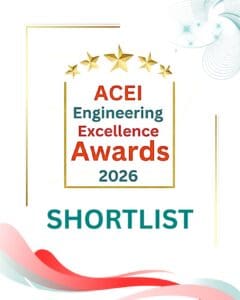
We are pleased to announce that the application process is now open for the ACEI Engineering Excellence Awards 2026 – Closing date has been extended to 23 January 2026
The full list of categories is provided below, and all engineering disciplines can apply as appropriate:
1) Civil
2) Structural
3) Mechanical & Electrical
4) Sustainability Built Environment
5) Sustainability Natural Environment
6) SME firm (up to 20 employees)
7) Project Management
8) Innovation
9) Overseas

Note: Applicants are required to review and familiarise themselves with the 2026 Awards Procedures before submitting nominations to ensure they have entered into the most appropriate categories.  The same project can be entered into multiple categories (eg Civil, SME & Innovation) however a separate application should be made for each project being submitted for consideration in more than one award category.

Closing date for receipt of project nominations: Friday 23 January 2026.

The shortlisted projects will be announced during Spring 2026.

We look forward to receiving many nominations for the 2026 Awards and applications are welcome for all project sizes, small, medium and large from all member firms.

** We particularly encourage nominations from SME firms (up to 20 employees) for all categories.

     ACCESS ENTRY FORMS HERE

Save the Date in your Diary Now!

The 2026 Awards Dinner will take place on the 27th March at the Intercontinental Hotel, Dublin 4.  Bookings will open in January 2026.

If you have any queries, please contact Louise at louise.patterson@acei.ie 

VISIT THE ACEI WEBSITE HERE

We are pleased to announce that the application process is now open for the ACEI Derrick Edge Future Leader Award 2026

Award Criteria

The 2026 ACEI Derrick Edge Future Leader award will be presented to a consulting engineer with excellent communication skills, business acumen, technical capabilities and strong ethical values. The award competition is a great opportunity to showcase your experience to date, add value to your credentials and be publicly recognised as a rising talent by the senior leaders in your profession.

Candidates are required to submit a written application including:

  • A description of the qualities and skills you believe you possess that meet the criteria of an ACEI Future Leader (max 400 words);
  • An outline of the main challenges currently facing the consulting engineering profession in Ireland and how you think they could / should be addressed and the role that ACEI could play in this context. (max 600 words);
  • A description of a project in which you played a key consulting engineering role. Demonstrate clearly how you met the client’s brief and brought excellence in design, innovation, sustainability, health and safety and value for money to the project (max 1200 words). Photos / images can also be included.
Entries should also include up to two other pages containing the following information:

  • Full name and date of birth of applicant;
  • Name of ACEI member company;
  • Qualifications obtained to date and CPD courses undertaken;
  • Brief career history including dates, company name(s) and position(s) held;
  • Professional memberships and voluntary committee / organisation activities;
  • Signature and supporting statement (max 200 words) from an ACEI Fellow (FConsEI)
To qualify for the competition applicants must satisfy the following criteria:

  • Be a Chartered Engineer;
  • Be 35 years of age or under on 31st March 2026;
  • Have four or more years relevant experience;
  • Be employed in an ACEI member company;
  • Be supported by an ACEI Fellow Professional Consulting Engineer (FConsEI).
Future Leader 2026 Applications collated in one pdf document should be sent by email to: louise.patterson@acei.ie not later than 5pm on Friday 23rd January 2026
The ACEI will set up an adjudicating panel to assess the applications and may chose a shortlist of up to five candidates. The short-listed candidates will need to make themselves available to undertake an interview with the panel in early February 2026 where two or three finalists will be selected. The finalists will be invited to submit their entry to the EFCA Future Leaders Award. The overall ACEI winner will be formally announced at the ACEI Annual Awards Dinner on 27th March in the Intercontinental Hotel, Dublin 4.

We are pleased to announce that the application process is now open for the ACEI Engineering Excellence Awards 2026 – Closing date has been extended to 23 January 2026
The full list of categories is provided below, and all engineering disciplines can apply as appropriate:
1) Civil
2) Structural
3) Mechanical & Electrical
4) Sustainability Built Environment
5) Sustainability Natural Environment
6) SME firm (up to 20 employees)
7) Project Management
8) Innovation
9) Overseas

Note: Applicants are required to review and familiarise themselves with the 2026 Awards Procedures before submitting nominations to ensure they have entered into the most appropriate categories.  The same project can be entered into multiple categories (eg Civil, SME & Innovation) however a separate application should be made for each project being submitted for consideration in more than one award category.

Closing date for receipt of project nominations: Friday 23 January 2026.

The shortlisted projects will be announced during Spring 2026.

We look forward to receiving many nominations for the 2026 Awards and applications are welcome for all project sizes, small, medium and large from all member firms.

** We particularly encourage nominations from SME firms (up to 20 employees) for all categories.

     ACCESS ENTRY FORMS HERE

Save the Date in your Diary Now!

The 2026 Awards Dinner will take place on the 27th March at the Intercontinental Hotel, Dublin 4.  Bookings will open in January 2026.

If you have any queries, please contact Louise at louise.patterson@acei.ie 

VISIT THE ACEI WEBSITE HERE

In this blog, I will look to address two key concerns across the sector:

· That consulting engineering firms are not doing qualifying R&D activity

· Submitting an R&D tax claim will act as a beachhead for Revenue into your business

At this year’s ACEI conference, President Tim Murnane suggested that every consulting engineering company in Ireland should be claiming R&D Tax Credits. And yet, many still believe that their work is simply ‘business as usual’ and therefore not eligible for R&D relief. But the truth is that if you’re solving technical problems, testing design alternatives, or developing tools your competitors don’t have, you very likely are doing R&D, and that means you’re completely entitled to make a claim. It’s all too common to think of lab work and white coats when hearing the words ‘research and development’, but the R&D Tax Credit isn’t just for scientists conducting test tube experiments. It’s also for engineering professionals who solve real-world problems.

Engineers drive innovation. Whether by finding a new way to integrate low-carbon materials, developing proprietary analysis tools, or designing an innovative structural system to meet a complex brief, engineers are constantly breaking new ground in a way that’s very likely to qualify as R&D.

It’s important to stress that R&D Tax Credits can be hugely valuable, allowing companies to claim up to 30% of qualifying expenditure (rising to 35% next year). Eligible projects can receive a tax credit on things like staff costs, overheads, raw materials and other expenses that are directly linked to your R&D activity. It all adds up, and in a challenging cost environment, can lead to a significant financial benefit. What about Revenue enquiries?

Another barrier to claiming is when companies fear the level of scrutiny they may face. To paraphrase a few conversations that I’ve had recently: ‘If we make a claim, aren’t we basically just inviting Revenue to crack open the books on our whole business?’

Let’s clear this up right now: that’s a complete myth. On the rare occasion that Revenue has raised an enquiry, Revenue will ask to see the

technical information that relates specifically to your R&D claim. As long as everything is properly documented and substantiated, then the enquiry is closed.

We know this from experience. At Leyton Ireland, we’ve supported 180 clients (including more than 25 ACEI member firms), helping them to prepare and submit their R&D Tax Credit claims. Around 120 of these companies are now in their second or third year of claiming, which just goes to show how accessible the scheme is. So, if you’re worried about an enquiry, the best advice is to speak to the experts.

Since launching in Ireland, we’ve supported more than 450 claims, and only six of these have resulted in a Level 1 enquiry (that’s just 1.3%). When this happens, we assist our clients by defending claims to make sure that they stand up to all scrutiny. Every single enquiry we’ve defended was positively resolved without any adjustment to what had originally been claimed. That’s a testament to the rigour of our technical team and our collaborative process.

We embed ourselves within organisations, speaking to key R&D project members such as design leads, directors, project engineers or anyone else who was directly involved in the effort. We do this so that we can build a clear narrative for Revenue that’s both compliant and defensible from the start.

Don’t just take it from me. One of our longstanding clients, EDC Consulting Engineers, recently shared:

“After every claim, we feel we’re a little bit wiser about the claims process, thanks to Leyton’s guidance. Over our time working together, Leyton has helped us better understand how to identify R&D projects and what is needed to prepare successful R&D Tax Credit claims.

We do very little of the work ourselves. Leyton handles most of the claim preparation process, which saves us a lot of time and hassle.”

Not sure if your work qualifies as R&D?

To be eligible for relief, there needs to have been systematic investigation in the face of a scientific or technological uncertainty. Most engineering projects that seek to make an advancement have a good chance of qualifying, but sometimes the technical jargon needs to be translated into a language that Revenue understands. That’s where we can help.

As a strategic partner of the ACEI, we work with engineering firms to uncover qualifying projects, before helping them to submit their claims with complete confidence.

We know that there’s huge pressure on the sector to deliver sustainable, efficient and digitally enabled solutions, but that’s exactly what’s driving innovation, much of which

qualifies for relief. And if you’re not claiming for that R&D, you’re leaving money on the table.

Yes, Revenue’s process is robust, but with the right guidance you can claim confidently (and compliantly) with a clear return to show for your hard work.

If you’re still not sure whether your work qualifies, we’ll be more than happy to have an initial conversation to discuss your eligibility for claiming. You’ve got nothing to lose, and nothing to fear.

— Darragh Gaffney is Head of R&D Incentives at Leyton Ireland. He leads a multidisciplinary team that has helped builders, engineers and innovators unlock over €300 million worth of R&D Tax Credits annually.

More information can be found here: Leyton Ireland | Boost Your Business Growth with our R&D Tax Credits services

Commenting on the 2026 Budget Director General Shane Dempsey said:
“We welcome the Government’s infrastructure ambition, but today’s Budget must now be coupled with a bonfire of the redtape that is strangling housing and infrastructure delivery.  Without this, a large proportion of the €116bn announced for infrastructure will evaporate due to delays, judicial reviews, and legal disputes.
We need to see — in full — the forthcoming report on removing barriers to infrastructure delivery in the regulatory system, and we must quickly move to put its recommendations into practice. The real test will be in how that report is deployed not the figures mentioned today.
In particular, reform of public sector procurement and tendering is essential.  Precluding the selection of the lowest bid and focussing on quality in public procurement will see better delivery, less delays and better turns across the lifeycle of projects.
Better contracting models, fairer risk sharing, earlier engagement between public clients and engineering firms, will see less of today’s investment diverted to legal issues and disputes.
The engineering sector stands ready to help design, deliver and maintain Ireland’s critical infrastructure — but Government policy must focus now on ensuring that funding commitments translate into delivered projects on the ground.”
To support this, ACEI calls on Government to:
  1. Make the ministerial report public immediately, including draft timelines for implementation and sectoral impact assessments.
  2. Embed procurement reform as a core component of delivery acceleration — including reducing overly burdensome procurement cycles, limiting repeated rounds of retendering, and ensuring transparent risk allocation.
  3. Lock in statutory or administrative timelines for decision-making across planning, environmental, grid and statutory approvals, with clear accountability and sanctions for delays.
  4. Limit the scope of judicial review appeals in clearly designated strategic infrastructure projects, while preserving fair access to challenge in appropriate contexts.
  5. Provide certainty in multi-annual funding to support multi-year projects and avoid stop / start cycles in delivery capacity.
  6. Build delivery capacity in the public sector – more project management resources, specialist procurement units, and better coordination across ministries and State Agencies.
ACEI Budget Submission: Failure to Reform Procurement Risks Delaying Thousands of Homes and Billions in Infrastructure
Dublin, [11 Sept. 25] – The Association of Consulting Engineers of Ireland (ACEI) today warned that unless the Government urgently adopts reforms set out in its Budget 2026 Submission, Ireland faces further severe delays to thousands of homes and billions of euro worth of vital infrastructure.
The submission outlines how Ireland’s housing and infrastructure delivery pipeline is being undermined by unfair contracting arrangements, underinvestment in digitalisation, and outdated procurement practices. Unless these issues are resolved, Ireland will fall further behind on the delivery of housing, transport, water and climate-critical projects, costing the State time, money, and social progress.
Procurement is Holding Ireland Back
A core ACEI policy recommendation is reform of public procurement to ensure that quality rather than lowest price is accepted.  Current practices reward unrealistically low prices that ultimately drive disputes, increase costs, and delay delivery. ACEI proposes a better system that prioritises bids closest to the median price – an approach that safeguards quality, discourages reckless undercutting, and ensures better value for the taxpayer.  The ACEI recommends that an 80/20 price quality ratio is utilised and that the bid closer to the median price be selected – this will effectively end underbidding and still generate value for money and quality innovation for the State.
“Lowest-price procurement is a false economy,” said ACEI Director General Shane Dempsey. “It strangles innovation, undermines collaboration, and creates bottlenecks that delay homes, schools, transport links, and water systems. Reform is cost-neutral and will immediately improve delivery outcomes.”
Housing and Infrastructure targets will never be achieved
The submission warns that unless Government acts, the State’s ability to deliver its own targets – including 60,000 new homes and critical infrastructure under the €200 billion National Development Plan – cannot be achieved in its lifetime or indeed at any point in the future.
Consulting engineers highlight that the design phase is the best opportunity to accelerate timelines, reduce costs, and cut carbon, yet current contractual barriers are pushing skilled firms away from public sector projects.
Dempsey stated, “Consulting Engineers are increasingly avoiding public sector projects due to the risk they pose to business vis-à-vis private sector projects.  The delays we see regularly arising from planning and the unfair risk they allocate to essentially SME businesses means that the attractiveness of critical housing and infrastructure projects is significantly diminished. For example, due to the overly legalistic approach of the likes of the Housing Finance Agency means that consulting engineers, all other things being equal, will select other projects to avoid risk.
Call for Action
ACEI is calling on Government to:
Reform procurement to prevent lowest-bid selection and adopt median-based tendering.
Resource contracting authorities with multi-annual budgets to give certainty and enable investment.
Accelerate digitalisation and skills investment to strengthen industry capacity.
Address unfair contract clauses and onerous collateral warranties that drive up insurance costs and deter participation.
“Budget 2026 is a once-in-a-generation opportunity,” said Dempsey. “Adopting these reforms will unlock delivery of homes and infrastructure at pace. Ignoring them will cost Ireland dearly – in lost time, lost homes, and lost competitiveness.”
Read our budget submission here.
For further information, please contact:
ACEI – Association of Consulting Engineers of Ireland
Tel: 00 353879884465
Email: shane.dempsey@acei.ie

Leyton, the global consultancy specialising in innovation funding, has appointed Darragh Gaffney as its new Irish Lead. This strategic move strengthens Leyton’s presence in Ireland, positioning the country as both an exciting step and a key hub in the firm’s international growth journey.

With over 25 years of experience supporting businesses to innovate through R&D tax credits, grant funding, and incentive schemes, Leyton has helped thousands of companies unlock financial value and reinvest in growth. Darragh’s appointment builds on this global expertise, ensuring Irish businesses can access world-class support while connecting more closely with Leyton’s international network.

Darragh brings a strong record of impact across the Irish innovation landscape. Previously R&D Director at Monaghan Biosciences and Director of Growth at the Industry Research & Development Group (IRDG), he has supported hundreds of businesses in securing millions of euros in innovation supports. He combines deep technical knowledge and funding expertise with a passion for sustainability and the circular economy.

Brian Graham, UK & Ireland Managing Director at Leyton, commented: “Ireland is an exciting step in Leyton’s international growth journey, and the appointment of Darragh is a pivotal appointment for our success in this market. His expertise and leadership will help establish Ireland as a hub for innovation support and a bridge to our wider global ambitions.”

Alongside his new role, Darragh sits on the Board of Natural Capital Ireland, further reinforcing Leyton’s commitment to environmental and sustainable innovation.

Commenting on his appointment, Darragh said: “I’m proud to join a company with global reach and a clear mission to help businesses innovate better. Ireland has immense potential to benefit from R&D tax credits and grant funding, and Leyton is uniquely placed to make those opportunities easier and more accessible for companies ready to grow.”

info@acei.ie
(01) 642 5588
  • ABOUT US
  • Who We Are
  • ACEI Affiliations
  • Executive Board
  • Why Work With ACEI Members?
  • Resources
  • What is a Consulting Engineer?
  • Find a Consulting Engineer
  • EDI Charter
  • BECOME A MEMBER
  • Membership Requirements
  • Apply for Membership
  • EVENTS & Training
  • ACEI Awards
  • News
  • Blog
  • Publications
  • Contact
  • ACEI
    22 Fitzwilliam Place
    Dublin 2
    D02 R820
    Ireland
  • MEMBERS LOGIN
The ACEI is a member of:

©Copyright 2024 ACEI - The Association of Consulting Engineers of Ireland. All rights reserved. | Privacy | Terms + Conditions | Cookie Preferences Tailored by iPLANiT

X
X