



Beale & Co welcomes Jeremy Curran as Construction Partner in Dublin.
Beale & Co is pleased to announce the appointment of Jeremy Curran as a Partner in the Firm’s Construction, Engineering and Infrastructure team in Dublin.
Jeremy joins from global law firm DLA Piper and brings over 20 years’ experience advising on construction matters across the residential, commercial, industrials, life sciences, infrastructure, and energy sectors.
He becomes part of the Firm’s leading Contracts and Projects Advisory team, where he will advise clients on all front-end project matters, including contract reviews and tender checks; contract formation and project procurement; tender procedures and competitions; negotiation and conclusion of contract documents; joint venturing and contractual entitlement; project variations; and dispute avoidance.
Originally qualified as a civil engineer, Jeremy has lived and worked in Australia, the Far East, the Middle East and Europe. He is admitted to practice in Ireland, England & Wales, and New South Wales (Australia).
Jeremy’s client base has included contractors, consultants, developers, investors, funders, non-bank lenders and end-users across multiple jurisdictions. In addition to his time in private practice, Jeremy has spent nine years as in-house counsel for a Dubai-based multinational, advising on both contentious and non-contentious construction matters.
Commenting on the appointment, Killian Dorney, Construction Partner and Head of the Firm’s Dublin office, said:
“We are very pleased to welcome Jeremy to the Partnership. His significant industry experience will be a huge benefit to our clients, the Dublin office and our wider Contracts and Projects Advisory team. With Jeremy’s support, we look forward to strengthening our position as a leading construction practice in Ireland and internationally.”
Jeremy added:
“I am excited to be joining Beale & Co and continuing my career at such an esteemed specialist firm. I look forward to working with colleagues across the Firm and contributing to its longstanding reputation in the construction, engineering and infrastructure sector.
Jeremy’s arrival further enhances Beale & Co’s position as a leading specialist firm for complex construction and infrastructure matters in the UK, Ireland, the UAE, Canada and globally.
To learn more about Jeremy, click here.
2026 ACEI Engineering Excellence Awards

Above: President Tim Murnane addresses attendees at Friday night’s award ceremony in Dublin
On Friday 27 March, we crowned new winners of the ACEI 2026 Engineering Excellence Awards.
In a packed-out Intercontinental Hotel, President Tim Murnane presented awards to each of the category winners as well as two special awards to Michael Moriarty, for a lifetime contribution to the sector, and Seán O’ Driscoll, for his recent work in the Accelerating Infrastructure Taskforce.
Over 400 people gathered to celebrate the achievements of our industry ahead of a period where consulting engineers will lead the way on infrastructure delivery in Ireland.
Congratulations to all our winners and to the fantastic projects which were shortlisted alongside them. ACEI would like to sincerely thank Richard Crowe and his supporting judges Anne Marie Conibear and John Purcell for all their thorough review of the project nominations to arrive at a shortlist and decide on the award winners.
Your 2026 ACEI Engineering Excellence Award Winning Projects are:
2026 Project of the Year: UCD O’Connor Centre for Learning (CFL) at University College Dublin submitted by Arup
Civil (Small): George’s Dock Luas Bridge Replacement by Roughan & O’Donovan Consulting Engineers
Civil (Medium): Marina Park and Promenade by O’Connor Sutton Cronin
Civil (Large): Project Roadrunner (Dexcom – Athenry), by Clifton Scannell Emerson Associates
Structural (Small): 180–187 Townsend Street, Dublin 2 with structural design by DBFL Consulting Engineers
Structural (Medium): Beamish and Crawford Bridges, Cork, with structural design by Arup
Structural (Large): The Treasury Building, Lower Grand Canal Street, Dublin 2 with structural design by CORA Consulting Engineers
M&E (Small): Connolly Hospital Blanchardstown Centralised Standby Power Supply Control System Project submitted by Varming Consulting Engineers
M&E (Medium): National High-Level Isolation Unit (NHLIU) Project at the Mater Hospital Dublin (MMUH) submitted by J V Tierney Consulting Engineers
M&E (Large): UCD O’Connor Centre for Learning (CFL) at University College Dublin submitted by Arup
Sustainability Built Environment (Small): 180 – 187 Townsend Street for the Peter McVerry Trust by DBFL Consulting Engineers
Sustainability Built Environment (Medium): Student Services Building, at the University of Limerick, by Don O’Malley and Partners Limited
Sustainability Built Environment (Large): The Treasury Building by CORA Consulting Engineers
Sustainability Natural Environment: Marina Park Promenade by O’Connor Sutton Cronin
Project Management (Small/Medium): Dublin Airport Authority Solar Farm by Nicholas O’Dwyer Ltd.
Project Management (Large): Killaloe Bypass, Brian Boru Bridge & R494 Improvement Scheme for Clare County Council by RPS Consulting Engineers
SME Category: The Shackleton Museum, Athy, Co. Kildare with structural, civil and fire engineering design by McCrae Consulting Engineers
Innovation (Small/Medium): Dublin Tunnel Tolling System Replacement Project by Arup
Innovation (Large): College Square by Waterman Moylan
Overseas: The Eades in Walthamstow, London, by Barrett Mahony Consulting Engineers




Celebrating the Future of Engineering Excellence
We’re thrilled to announce the four incredible finalists for this year’s ACEI Future Leaders’ Competition! These incredible young professionals, judged on innovation, leadership and excellence, are set to shape the future of our industry as Ireland seeks to deliver on its infrastructural promise.
🏆 Meet the Finalists:
Niall O’Brien of Egis
Aisling Hahessy of Arup
Andries (Andy) Kotze of Donnachadh O’Brien & Associates and
Mumo M Bonaya of Mott MacDonald
A huge congratulations to our four finalists! 👏👏
The winner will be revealed on March 27th at the ACEI Annual Awards 2026 – celebrating the very best in consulting engineering.
📅 Date: March 27, 2026
📍 Location: Intercontinental Hotel, Ballsbridge
🕖 Time: 7:00 PM
We are delighted to announce the shortlist of projects for the 2026 Engineering Excellence Awards. There was a record number of entries this year, thanks to all firms who entered.
Congratulations to all of the shortlisted firms and projects, which can be seen here.
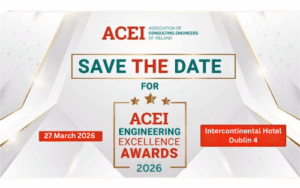
The presentation of the awards takes place at the Gala Dinner on Friday 27th March in the Intercontinental Hotel, Dublin 4. Tickets are selling fast! So don’t miss out – book your table today!
We look forward to welcoming ACEI members and guests on the night.
|

|

|
In this blog, I will look to address two key concerns across the sector:
· That consulting engineering firms are not doing qualifying R&D activity
· Submitting an R&D tax claim will act as a beachhead for Revenue into your business
At this year’s ACEI conference, President Tim Murnane suggested that every consulting engineering company in Ireland should be claiming R&D Tax Credits. And yet, many still believe that their work is simply ‘business as usual’ and therefore not eligible for R&D relief. But the truth is that if you’re solving technical problems, testing design alternatives, or developing tools your competitors don’t have, you very likely are doing R&D, and that means you’re completely entitled to make a claim. It’s all too common to think of lab work and white coats when hearing the words ‘research and development’, but the R&D Tax Credit isn’t just for scientists conducting test tube experiments. It’s also for engineering professionals who solve real-world problems.
Engineers drive innovation. Whether by finding a new way to integrate low-carbon materials, developing proprietary analysis tools, or designing an innovative structural system to meet a complex brief, engineers are constantly breaking new ground in a way that’s very likely to qualify as R&D.
It’s important to stress that R&D Tax Credits can be hugely valuable, allowing companies to claim up to 30% of qualifying expenditure (rising to 35% next year). Eligible projects can receive a tax credit on things like staff costs, overheads, raw materials and other expenses that are directly linked to your R&D activity. It all adds up, and in a challenging cost environment, can lead to a significant financial benefit. What about Revenue enquiries?
Another barrier to claiming is when companies fear the level of scrutiny they may face. To paraphrase a few conversations that I’ve had recently: ‘If we make a claim, aren’t we basically just inviting Revenue to crack open the books on our whole business?’
Let’s clear this up right now: that’s a complete myth. On the rare occasion that Revenue has raised an enquiry, Revenue will ask to see the
technical information that relates specifically to your R&D claim. As long as everything is properly documented and substantiated, then the enquiry is closed.
We know this from experience. At Leyton Ireland, we’ve supported 180 clients (including more than 25 ACEI member firms), helping them to prepare and submit their R&D Tax Credit claims. Around 120 of these companies are now in their second or third year of claiming, which just goes to show how accessible the scheme is. So, if you’re worried about an enquiry, the best advice is to speak to the experts.
Since launching in Ireland, we’ve supported more than 450 claims, and only six of these have resulted in a Level 1 enquiry (that’s just 1.3%). When this happens, we assist our clients by defending claims to make sure that they stand up to all scrutiny. Every single enquiry we’ve defended was positively resolved without any adjustment to what had originally been claimed. That’s a testament to the rigour of our technical team and our collaborative process.
We embed ourselves within organisations, speaking to key R&D project members such as design leads, directors, project engineers or anyone else who was directly involved in the effort. We do this so that we can build a clear narrative for Revenue that’s both compliant and defensible from the start.
Don’t just take it from me. One of our longstanding clients, EDC Consulting Engineers, recently shared:
“After every claim, we feel we’re a little bit wiser about the claims process, thanks to Leyton’s guidance. Over our time working together, Leyton has helped us better understand how to identify R&D projects and what is needed to prepare successful R&D Tax Credit claims.
We do very little of the work ourselves. Leyton handles most of the claim preparation process, which saves us a lot of time and hassle.”
Not sure if your work qualifies as R&D?
To be eligible for relief, there needs to have been systematic investigation in the face of a scientific or technological uncertainty. Most engineering projects that seek to make an advancement have a good chance of qualifying, but sometimes the technical jargon needs to be translated into a language that Revenue understands. That’s where we can help.
As a strategic partner of the ACEI, we work with engineering firms to uncover qualifying projects, before helping them to submit their claims with complete confidence.
We know that there’s huge pressure on the sector to deliver sustainable, efficient and digitally enabled solutions, but that’s exactly what’s driving innovation, much of which
qualifies for relief. And if you’re not claiming for that R&D, you’re leaving money on the table.
Yes, Revenue’s process is robust, but with the right guidance you can claim confidently (and compliantly) with a clear return to show for your hard work.
If you’re still not sure whether your work qualifies, we’ll be more than happy to have an initial conversation to discuss your eligibility for claiming. You’ve got nothing to lose, and nothing to fear.
— Darragh Gaffney is Head of R&D Incentives at Leyton Ireland. He leads a multidisciplinary team that has helped builders, engineers and innovators unlock over €300 million worth of R&D Tax Credits annually.
More information can be found here: Leyton Ireland | Boost Your Business Growth with our R&D Tax Credits services
During the Presidential campaign, an interesting issue arose where the type of work carried out by the ultimately successful candidate, and President, Ms Catherine Connolly was raised. This was in the context of Ms Connolly (a barrister), acting in her professional capacity, allegedly represented financial institutions repossessing homes of ordinary citizens. The allegation was that this type of work carried out by Ms Connolly “the barrister” appeared to conflict with the strongly held views of Ms Connolly “the socialist politician”, who opposed such actions by banks and stood firmly behind the normal citizen as a victim in this context. Ms Connolly was asked to explain this apparent Dr Geckle and Mr Hyde scenario.
I am interested in this from an ACEI perspective for two reasons. Firstly, in the context of my desire for the development of a best in class community of Consulting Engineers, led by the ACEI, it was interesting to see how the community of legal professionals responded to the above challenge of Ms Connolly. Led by Minister for Justice Jim O’Callaghan (also a barrister), who is on the opposing side of the political divide to Ms Connolly, the defence of Ms Connolly to act as a barrister in this context was fulsome and complete. He was 100% behind his political foe for her right to conduct her legal duties regardless of the apparent political contradiction. And while in the legal profession there is a “cab-rank” rule, which does not apply in Consulting Engineering, in essence the legal profession was “circling the wagons” and this took precedence over their opposing political perspectives. In most such circumstances, political allegiance would take precedence – not in this case though! I found this interesting and something we need to reflect on as Consulting Engineers. Protecting our profession and its reputation should also take precedence in all circumstances and that is what I would love to see, as a best in class community of professionals, who support each other first and foremost. That is an essential component of a vibrant, successful and thriving profession.
The second component of this I wish to explore, relates to Engineering parallels with Ms Connolly’s scenario i.e. Engineers choosing to perform roles that appear to be anti development. The primary role of Consulting Engineers, as per the ACEI mission statement, is to “….deliver sustainable engineering solutions for the benefit of humankind”. It goes without saying that to achieve this, there must be new construction work, whether that is the development of housing, to help solve the housing crisis, or other fundamental infrastructure to support the growing demands of our nation. How do we respond, when a client asks us to support them to block a planning permission, which we feel may be for spurious reasons, without reasonable or balanced engineering concerns? Are we happy and are we doing justice to our noble profession, when we prepare a report in support of a planning appeal in such circumstance, be that to An Coimisiún Pleanála or Judicial Review? Are we comfortable to suspend our primary duty as Consulting Engineers to apply our expertize to support development and the benefits that result for wider society, or are we comfortable to do the opposite? Food for thought I dare say and as one of my former colleagues used say “I will leave it with you”…….
“We welcome the Government’s infrastructure ambition, but today’s Budget must now be coupled with a bonfire of the redtape that is strangling housing and infrastructure delivery. Without this, a large proportion of the €116bn announced for infrastructure will evaporate due to delays, judicial reviews, and legal disputes.We need to see — in full — the forthcoming report on removing barriers to infrastructure delivery in the regulatory system, and we must quickly move to put its recommendations into practice. The real test will be in how that report is deployed not the figures mentioned today.In particular, reform of public sector procurement and tendering is essential. Precluding the selection of the lowest bid and focussing on quality in public procurement will see better delivery, less delays and better turns across the lifeycle of projects.Better contracting models, fairer risk sharing, earlier engagement between public clients and engineering firms, will see less of today’s investment diverted to legal issues and disputes.The engineering sector stands ready to help design, deliver and maintain Ireland’s critical infrastructure — but Government policy must focus now on ensuring that funding commitments translate into delivered projects on the ground.”
-
Make the ministerial report public immediately, including draft timelines for implementation and sectoral impact assessments.
-
Embed procurement reform as a core component of delivery acceleration — including reducing overly burdensome procurement cycles, limiting repeated rounds of retendering, and ensuring transparent risk allocation.
-
Lock in statutory or administrative timelines for decision-making across planning, environmental, grid and statutory approvals, with clear accountability and sanctions for delays.
-
Limit the scope of judicial review appeals in clearly designated strategic infrastructure projects, while preserving fair access to challenge in appropriate contexts.
-
Provide certainty in multi-annual funding to support multi-year projects and avoid stop / start cycles in delivery capacity.
-
Build delivery capacity in the public sector – more project management resources, specialist procurement units, and better coordination across ministries and State Agencies.